
Founders don’t need a definition of “business consulting.” They need to know what a consultant actually does that they can’t do themselves, what it costs, and how to tell a good one from a firm reselling the same license package as everyone else.
What business consulting for a startup should actually cover
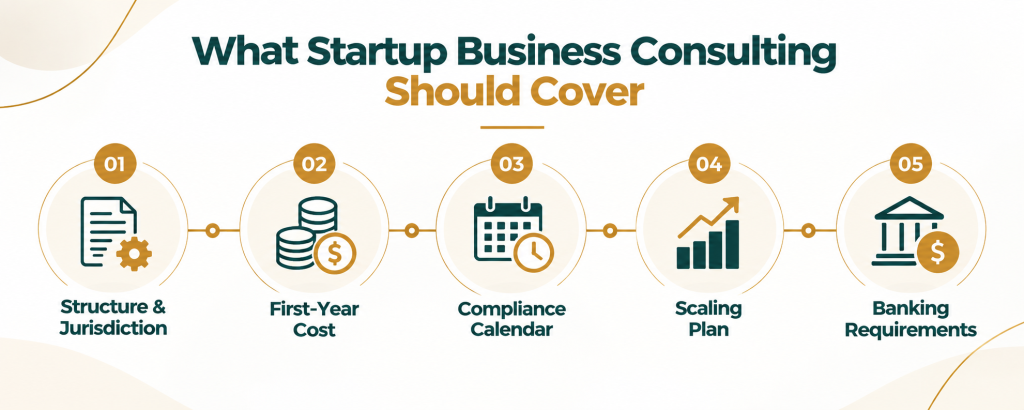
Strip away the marketing language and a real consulting engagement answers five specific questions before any paperwork is filed:
- Which activity code and jurisdiction actually fit your model (not the cheapest one, the right one). A digital agency serving UAE clients and a digital agency serving only international clients need different structures, even if the “consulting” activity code looks identical on paper.
- What your realistic first-year cost is, including visas, office, and banking, not just the license fee. Setup costs for a lean free zone company run roughly AED 18,000–25,000 in year one; a mainland company with an office and one visa runs AED 30,000–50,000+. A consultant should model your actual number, not quote the cheapest package on their price list.
- What your compliance calendar looks like for the first 18 months: license renewal, VAT threshold monitoring, corporate tax registration timing, visa renewals.
- Whether your structure will survive scaling without a rebuild, hiring five people, adding a second activity, bringing in an investor.
- What banks will actually ask for, so your bank account application isn’t the thing that stalls your launch by six weeks.
If a consultation doesn’t touch at least four of these five, it’s a sales call for a setup package, not consulting.
What it costs
Consulting and execution are usually priced separately, and it’s worth knowing which one you’re paying for:
- One-time advisory or structuring fee: roughly AED 1,500–5,000, typically covering jurisdiction comparison, activity selection, and a cost roadmap before you commit to a package
- Ongoing retainer: bundles advisory with PRO and compliance work, often the same AED 1,500–5,000 range but billed monthly rather than once
- Bookkeeping, if bundled in: AED 500–1,000/month for an early-stage startup, AED 2,000–4,000/month once you’re SME-sized
None of this includes the government fees and license costs covered in our guide to starting a business in Dubai, which is the number founders usually confuse with the consulting fee. They’re two different line items.
When you actually need a consultant, and when you don’t
A solo founder with a simple service activity, no local clients, and a straightforward flexi-desk free zone setup can often self-serve through a free zone’s own onboarding team. The calculus changes once any of these apply:
- Your activity needs regulatory approval beyond DET (financial, healthcare, education, F&B)
- You’re choosing between mainland and free zone and the answer isn’t obvious
- You’ll need multiple visas or a physical office from day one
- You have foreign co-founders or investors with cross-border tax questions
- You’re planning to scale within 12 months and don’t want to rebuild the structure to do it
What to look for, and what to avoid
Good signs: they ask about your activity and customers before naming a jurisdiction; they show you at least two structural options with real trade-offs, not one recommendation; they separate the advisory fee from execution costs in writing; they can name specific compliance dates (VAT threshold, tax registration deadline) relevant to your business, not generic reminders.
Red flags: a jurisdiction recommendation before they’ve asked what you sell or to whom; a single “best package” with no comparison; pressure to pay the full setup fee before any structural review; vague answers about what’s included versus billed as an extra.
Setup and growth are one process, not two
The most expensive mistake isn’t picking the wrong consultant, it’s treating structuring and growth as separate problems. A company built only for launch, without visa headroom, banking flexibility, or an activity code that covers where the business is going, often needs a partial rebuild within a year. Founders who plan business registration in Dubai with their 18-month plan in mind, not just their launch date, avoid that rework.
That’s also where the supporting pieces matter: coordinating PRO services in Dubai for visas and government liaison, keeping legal compliance services in Dubai current as the business grows, and setting up with a financial advisor in Dubai rather than bolting on bookkeeping after the fact. Startups that use one coordinated business support services partner across these pieces generally move faster than ones juggling separate providers for each.
Bottom line
Good consulting isn’t a sales pitch dressed up as advice, it’s a structural decision made with your actual numbers, not a template. If a consultant can’t tell you your realistic first-year cost, your compliance calendar, and at least one alternative structure they considered and rejected for you, they haven’t done the consulting part yet.
FAQ
What does a business consulting service for startups in Dubai actually include?
A proper engagement covers activity and jurisdiction selection, a realistic first-year cost model, a compliance calendar for licensing, VAT, and corporate tax, and guidance on how the structure holds up as you scale. It should end with a written comparison of at least two structural options, not a single recommendation.
How much does startup business consulting cost in Dubai?
A one-time advisory or structuring engagement typically runs AED 1,500 to 5,000. Ongoing retainers that bundle advisory with PRO and compliance work fall in a similar monthly range. This is separate from government license fees and setup costs, which are covered in our guide to starting a business in Dubai.
Do I need a consultant, or can I set up a company myself in Dubai?
A simple solo setup with a standard service activity and no local clients can often be self-served through a free zone’s own onboarding team. A consultant earns their fee once you’re choosing between mainland and free zone, need multiple visas, have foreign co-founders, or expect to scale within a year.
How is business consulting different from PRO services?
PRO services execute government-facing tasks such as visa processing, license renewals, and document clearing. Consulting happens earlier, deciding which structure, jurisdiction, and activity to set up in the first place. Many startups need both; some only need PRO services once the structural decisions are already made.
What questions should I ask before hiring a business consultant in Dubai?
Ask what your realistic first-year cost is including visas and office, what compliance dates apply to your specific activity, what alternative structures they considered and why they ruled them out, and whether the advisory fee is separate from execution costs. Vague answers to any of these are a signal to keep looking.
Can one consultant handle both setup and ongoing compliance?
Yes, and it’s usually more efficient than using separate providers. A single business support services partner coordinating registration, PRO work, and compliance reduces the handoff gaps that cause delays when three different firms aren’t talking to each other.