
Starting a business in Dubai comes with an important practical decision: where will the business actually operate?
For startups, commercial real estate in Dubai is not simply about finding an attractive office. The right property needs to match the company’s budget, business activity, team size, customer requirements and plans for growth.
A startup may begin with a flexible workspace or serviced office and later move into a dedicated commercial property. Others may need a client-facing office, retail space, warehouse or another type of commercial premises from the beginning.
The key is to choose a property that supports the business without creating unnecessary costs or limiting future growth.
Why Commercial Real Estate Matters for Startups in Dubai
For a startup, real estate is often one of the earliest significant operating commitments.
The property you choose can influence:
- Monthly operating costs
- Business location and accessibility
- Client experience
- Employee convenience
- Workspace capacity
- Licensing requirements
- Visa requirements
- Future expansion
- Overall business image
This makes commercial property a business decision rather than simply a rental decision.
Dubai offers different business setup routes, including mainland and free zone structures, and the requirements can vary depending on the jurisdiction and business activity. The Dubai Government also notes that free-zone setup costs can vary based on factors such as office space and the number of visas required.
For this reason, startups should consider their property requirements alongside their business structure rather than treating real estate as a separate decision.
What Types of Commercial Real Estate Can Startups Consider?
There is no single property type that works for every startup. The right option depends on how the company operates and how much physical space it actually needs.
1. Co-Working Spaces
Co-working spaces can be suitable for founders, freelancers, small teams and early-stage startups that do not need a dedicated commercial office.
They can provide access to a professional working environment while allowing startups to avoid committing to a large office from day one.
Depending on the provider, facilities may include:
- Shared workspaces
- Meeting rooms
- Internet connectivity
- Reception services
- Common areas
- Flexible leasing options
Co-working can be particularly useful when the startup is still testing its business model or building its initial team.
2. Serviced Offices
A serviced office provides a more dedicated workspace while reducing the need for the startup to manage every aspect of the property independently.
Depending on the provider, the package may include furniture, utilities, reception facilities, meeting rooms and maintenance.
This can make serviced offices suitable for startups that want a professional business environment but are not ready for the commitment associated with a traditional commercial lease.
3. Traditional Commercial Offices
A traditional commercial office provides greater control over the workspace, branding, layout and day-to-day environment.
This can be appropriate for startups that already have a growing team or regularly meet clients and business partners.
However, founders should consider more than the monthly rent. The total commitment can include deposits, fit-out, furnishing, utilities, maintenance and other property-related costs.
4. Retail and Commercial Units
Some startups need a customer-facing location rather than a conventional office.
Retail startups, food businesses, specialised service providers and certain trading businesses may require commercial premises designed for their particular activities.
In these cases, the property should be assessed alongside the relevant licensing and regulatory requirements before signing a lease.
5. Warehouses and Industrial Spaces
Startups involved in e-commerce, logistics, manufacturing, distribution or inventory-based businesses may require warehouse or industrial space.
For these businesses, factors such as storage capacity, loading access, transport connections, location and permitted use can become more important than a traditional office address.
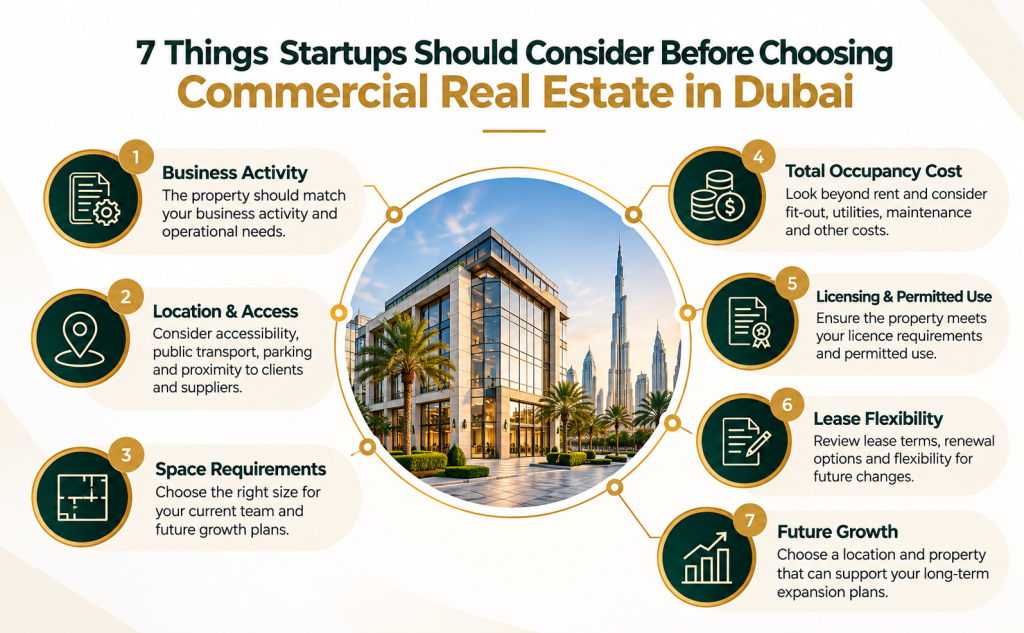
How Much Does Commercial Real Estate Cost in Dubai?
There is no single cost for commercial real estate in Dubai.
The total cost can depend on:
- Location
- Property type
- Office or unit size
- Lease duration
- Building quality
- Fit-out requirements
- Furnishing
- Utilities
- Maintenance
- Parking
- Business activity
- Additional facilities
For startups, comparing the advertised rental price alone can be misleading.
A property with a lower rent may require significant fit-out spending, while a serviced office may have a higher monthly cost but include furniture, utilities and other services.
The better approach is to calculate the total occupancy cost and compare it with the startup’s expected revenue, staffing plans and available working capital.
How Startups Should Choose a Commercial Property Location
Location can have a direct impact on how a startup operates.
The right location depends on who needs to access the property and what the business does.
Accessibility
Consider how easily employees, clients, suppliers and business partners can reach the property.
Public Transport
For startups with employees commuting regularly, proximity to public transport can make the workplace more convenient.
Parking
Parking may be important for businesses that regularly receive customers or have employees travelling by car.
Proximity to Customers
A startup that relies heavily on face-to-face meetings may benefit from being closer to its target customers and business districts.
Proximity to Suppliers and Logistics
For trading, e-commerce and logistics businesses, access to major roads, ports, airports or distribution areas may be more important than having a premium office address.
Future Expansion
A startup should also consider whether the location will remain practical as the company grows.
Moving offices too frequently can create additional costs, operational disruption and administrative work.
Commercial Real Estate and Business Licensing
The property should be compatible with the startup’s business activity and licensing structure.
This is particularly important because different business activities and jurisdictions can have different requirements.
Before committing to a commercial property, startups should consider:
- Business activity
- Licence type
- Mainland or free zone jurisdiction
- Permitted use of the property
- Required office or commercial space
- Number of employees
- Visa requirements
- Future expansion plans
Dubai’s official business setup guidance distinguishes between mainland and free-zone structures, with free zones operating under their own authorities and rules.
The property decision should therefore be made with the licensing structure in mind.
Should a Startup Buy or Lease Commercial Property?
For many startups, leasing provides more flexibility during the early stages of the business.
Leasing can allow a company to:
- Preserve capital
- Start with a smaller space
- Adjust the workspace as the team grows
- Avoid committing capital to property ownership
Buying commercial property can be relevant for businesses with longer-term plans, sufficient capital and a strategic reason to own their premises.
The decision should depend on the startup’s financial position, operating model, growth plans and long-term property requirements.
What Should Startups Check Before Signing a Commercial Lease?
Before signing a lease, founders should review the property carefully rather than focusing only on rent.
Important considerations include:
- Permitted use of the property
- Lease duration
- Renewal conditions
- Security deposit
- Payment terms
- Fit-out requirements
- Maintenance responsibilities
- Utility costs
- Parking availability
- Meeting facilities
- Signage permissions
- Expansion possibilities
- Registration requirements
Dubai Land Department provides services related to registering and renewing tenancy contracts, and its official platforms also provide access to rental-related information and services.
Having the commercial and administrative requirements reviewed before committing can help reduce avoidable problems later.
Common Commercial Real Estate Mistakes Startups Make
Startups can make several mistakes when choosing commercial property.
Choosing Based Only on Price
The cheapest property may not provide the location, facilities or flexibility the business needs.
Taking Too Much Space Too Early
A large office can create unnecessary fixed costs when the team is still small.
Ignoring Future Growth
Choosing a property that cannot accommodate additional employees can force an expensive move sooner than expected.
Signing Before Checking Requirements
The property should be checked against the company’s business activity and licensing requirements before the lease is signed.
Underestimating Additional Costs
Rent is only one part of the total occupancy cost. Deposits, fit-out, utilities, maintenance and other expenses can significantly affect the startup’s budget.
How Startups Can Plan Commercial Real Estate More Efficiently
A practical approach is to start with the business model rather than the property.
First, determine:
- What the business does
- Where the customers are
- How many employees are expected
- What type of premises are required
- What the startup can realistically spend
- Whether the company needs flexibility
- How quickly the business is expected to grow
Once these factors are clear, the property search becomes much more focused.
A startup can then compare co-working spaces, serviced offices, traditional commercial offices, retail premises or warehouses based on actual requirements instead of choosing a property simply because it looks attractive.
Commercial Real Estate Should Support Startup Growth
The right commercial property should help a startup operate efficiently without putting unnecessary pressure on its finances.
For an early-stage business, flexibility may be more important than having a prestigious address. For a growing company, a dedicated office may become more valuable as the team and customer base expand.
There is no single commercial real estate solution that works for every startup.
The right choice depends on the company’s business activity, budget, team, customers, licensing structure and growth plans.
Get Commercial Real Estate Support in Dubai
Finding the right property can take time, especially when the startup also needs to coordinate business setup, licensing, office requirements and other administrative processes.
IndexPro provides real estate solutions in Dubai covering commercial offices, virtual offices, co-working spaces and other property requirements.
The team can help startups evaluate property options based on their business objectives, location requirements and operating plans.
Startups can also consider business support services in Dubai for ongoing administrative assistance and market-entry support.
For startups that are also planning their company formation, new company setup in Dubai can be considered as part of the wider business setup process.
Choose Commercial Real Estate With the Business in Mind
Commercial real estate should be treated as part of the startup’s wider business strategy.
The right property can provide a practical working environment, support employees, improve client accessibility and give the company room to grow. The wrong property can create unnecessary costs and operational limitations.
Before choosing commercial real estate for startups in Dubai, consider the business activity, licensing structure, location, property type, total cost and future growth plans.
A well-planned property decision gives a startup a stronger foundation to operate, adapt and grow in Dubai.