
The first surprise for many founders entering the UAE is not the licensing process. It is how quickly early costs stack up once the business moves from idea to execution. Financial planning for a new business in the UAE needs to happen before incorporation is complete, not after. If the numbers are built too late, founders often overcommit on office space, underestimate working capital, or choose a structure that looks cheaper upfront but becomes costly to maintain.
A strong plan does more than tell you how much money you need to launch. It helps you figure out what kind of business you can realistically run, how long your capital will last, and when the company should start making enough money to stay afloat. In the UAE, where setup choices directly affect licensing, visas, banking, compliance, and operational costs, financial planning is tied closely to strategy.
Why financial planning matters early
In many markets, founders can test loosely and fix the financial model later. In the UAE, that approach creates avoidable risk. Your legal structure, jurisdiction, visa requirements, office arrangement, and activity classification all have cost implications from day one. A founder who is clear on the business concept but vague on the financial model can still make expensive decisions.
An example is a business choosing a license type that appears to allow them to operate but does not align with their short-term revenue expectations. Or they may budget for registration fees but not include other recurring costs such as renewals, accounting support, payroll administration, VAT compliance, insurance, or hiring employees. These are not minor details. They shape cash flow in the first 12 months, which is when most starting new businesses are at their most fragile.
Good planning creates room for decision-making. It gives founders a way to compare options, test assumptions, and avoid tying up too much capital in areas that do not generate early returns.
Start with the real cost of setup
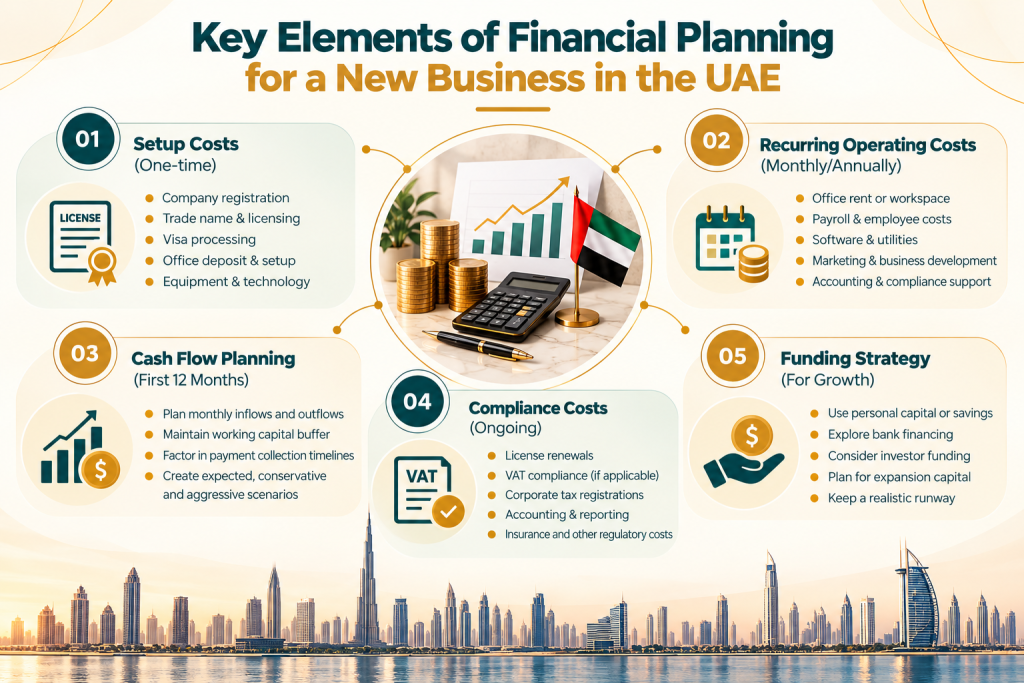
The first financial model should separate one-time setup costs from recurring operating costs. That sounds simple, but many first-time founders combine everything into one rough launch number and lose visibility almost immediately.
One-time costs may include company registration, trade name reservation, licensing, visa processing, initial document clearing, legal drafting, office deposits, equipment, branding, and technology setup. Recurring costs usually include rent or workspace fees, license renewals, payroll, software subscriptions, utilities, telecom, accounting, compliance support, marketing, banking charges, and transport.
As a rough planning reference, a lean free zone setup often lands in the AED 18,000–25,000 range for year one, while a mainland company with a physical office typically runs AED 30,000–50,000+. These are general 2026 market ranges, not a quote, since your actual number depends on activity, jurisdiction, and headcount. See the full breakdown in our guide to starting a business in Dubai.
Disclaimer: cost figures throughout this article are indicative, drawn from general UAE market data as of 2026, not confirmed IndexPro pricing. Confirm exact costs for your specific business with an advisor before finalizing a budget.
In the UAE, the exact mix depends on whether the business is mainland, free zone, or part of a broader expansion strategy. A lean service business may be able to start with relatively modest infrastructure, while a trading company or operationally intensive business may need more upfront capital. The wrong assumption is thinking there is one standard startup budget for every company entering Dubai or the wider UAE. There is not. The budget should match the activity, growth plan, and ownership structure.
Build a cash flow plan before a profit forecast
Many founders ask when the business will become profitable. That matters, but cash flow matters first. A business can look profitable on paper and still run into pressure if collections are delayed, supplier terms are unfavorable, or setup costs hit earlier than expected.
A practical starting point is a 12-month monthly cash flow forecast. This should show when money comes in, when it goes out, and how much buffer the company needs to maintain operations. In the UAE, this is especially important for businesses that will invoice corporate clients on 30- to 90-day terms. If payroll, rent, and renewals are due monthly but revenue is collected later, the business needs enough working capital to absorb the gap.
It also helps to model three versions of the year: expected, conservative, and aggressive. The conservative model is often the most valuable. It forces the founder to ask difficult but necessary questions. What if sales take three months longer than planned? What if one major client delays payment? What if a visa-related hire starts later than expected? Planning for these scenarios does not slow growth. It protects it.
Budget for compliance, not just operations
One common pitfall in financial planning for a new UAE business is to treat compliance as an afterthought. Founders naturally focus on costs to launch, acquire customers and hire. But regulatory and financial obligations continue after setup, and they need to be funded properly.
Two thresholds worth building into any plan from day one: VAT registration becomes mandatory once taxable turnover crosses AED 375,000 (voluntary from AED 187,500), covered in our VAT registration guide; and corporate tax applies at 9% on net profit above AED 375,000, detailed in our corporate tax guide. Neither is urgent in week one, but both become urgent quickly if they’re not budgeted for.
This is also where financial planning and bookkeeping do different jobs. Bookkeeping is the operational record-keeping that produces accurate monthly numbers. Financial planning uses those numbers, and the ones you project before you have them, to decide budget, runway, and funding strategy. A new business typically needs the planning piece first, then bookkeeping running alongside it from the first transaction.
There is also a broader strategic point here. Investors, banks, and commercial partners tend to respond better to businesses with organized financial records and visible compliance discipline. A founder who plans for this early is not just avoiding penalties. They are building credibility.
Match the business model to the market reality
Financial planning should reflect how business is actually won in the UAE, not how it works in another country. This is where many foreign investors misjudge timing. They may expect immediate traction because the market is active and opportunity-rich, but customer acquisition can still take time. The sales cycle is usually a combination of relationship building, price adaptation, market positioning and local proof of capability.
That means revenue forecasts should be grounded in market behavior. A company selling B2B services may need a longer runway before contracts stabilize. Retail businesses can have seasonal cycles. A consultancy may start with founder-led sales and low fixed costs, while a logistics or staffing company may need more operational cash from the outset.
The useful question is not just, “How much can this business make?” It is, “How does this business earn revenue in this market, and how long does that process take?” Once that is clear, pricing, staffing, and marketing spend become easier to plan.
Keep fixed costs low until demand is proven
Founders often want to establish credibility quickly, and in Dubai that can lead to spending too much, too soon. Premium office space, bigger teams, branded fit-outs and big launch campaigns might make a good first impression but they also push up the monthly break-even point.
In the early stage, flexibility usually beats scale. It is often better to start with a structure that supports compliance and professional operations without loading the business with unnecessary fixed commitments. That does not mean being underprepared. It means aligning spending with validated demand.
There are exceptions. Some businesses need visible infrastructure from day one because clients, regulators or operational needs require it. But many service-led companies can start lean and grow as recurring revenue becomes more predictable. The discipline to delay nonessential spending is often what preserves growth capacity later.
Choose funding with clear trade-offs in mind
Not every new business in the UAE needs outside funding, but every founder needs a funding plan. Self-funding is empowering but can slow your momentum. Partner capital can increase your launch capacity but requires clear agreements. Debt can help you maintain your equity but repayment pressures can affect your early cash flow. Most UAE banks require you to have a trading history (usually 12-18 months) before lending to your business, which is why very early-stage businesses tend to rely on self-funding, partner capital or investors rather than bank debt. Investor funding can accelerate your growth but only if your business is structured and reported in a manner suitable for due diligence.
The right route depends on the business model, the founder’s appetite for risk and the expected route to revenue. A low overhead consultancy may be better with disciplined self-funding. A business with inventory needs or higher start-up needs may require a different structure. What matters is that the funding approach matches the actual operating rhythm of the company.
This is also where professional guidance from a financial advisor adds real value. An experienced local advisor can help founders weigh setup costs, jurisdiction choices, and operational timing together rather than treating them as separate decisions. For businesses entering Dubai with growth ambitions, that coordination often saves more than it costs.
Treat financial planning as an operating tool
The strongest founders do not build a financial plan once and file it away. They use it monthly. They compare forecast to actual performance, watch where assumptions were wrong, and adjust early. That habit matters in the UAE because the market moves quickly, and business conditions can shift with hiring plans, client pipelines, and regulatory timelines.
A useful financial plan should answer practical questions. Can the business support another hire this quarter? Is the current pricing model sustainable after overhead? Are collections keeping pace with sales? Is the company ready for tax obligations and renewals without a cash squeeze? Those answers should come from a live operating model, built on accurate bookkeeping, not guesswork.
For new founders, the goal is not to build a perfect spreadsheet. It is to create enough clarity to make confident decisions. That is where financial planning becomes a growth tool rather than just an accounting exercise.
Starting a business in the UAE rewards ambition, but it rewards preparation even more. If your numbers are realistic, your structure fits the business, and your cash flow is planned with discipline, you give your company something every founder needs in the first year: breathing room to grow with confidence.
FAQ
How much does it cost to start a business in the UAE?
Indicative 2026 market ranges run roughly AED 18,000–25,000 for a lean free zone setup and AED 30,000–50,000+ for a mainland company with a physical office, though this varies by activity and structure. These are general figures, not a quote. See our full setup cost breakdown and confirm your specific number with an advisor before budgeting.
When should a new business start financial planning in the UAE?
Before incorporation is complete. Structure, jurisdiction, and licensing decisions all carry cost implications, so building the financial model after those choices are locked in often means discovering the numbers don’t work when it’s already expensive to change course.
What’s the difference between financial planning and bookkeeping?
Financial planning is forward-looking: budgeting, cash flow forecasting, and funding strategy. Bookkeeping is the operational record-keeping, transactions, reconciliation, and monthly reporting, that financial planning relies on once the business is running. New businesses typically need planning first and bookkeeping from the first transaction onward.
When does a new UAE business need to register for VAT and corporate tax?
VAT registration is mandatory once taxable turnover exceeds AED 375,000 (voluntary from AED 187,500). Corporate tax applies at 9% on net profit above AED 375,000, with 0% below that threshold. Both should be built into the financial plan from the start rather than addressed only once the thresholds are reached.
Does a new business in the UAE need outside funding?
Not necessarily. Self-funding, partner capital, debt, and investor funding all carry different trade-offs around control, speed, and reporting requirements. Most UAE banks also require 12–18 months of trading history before extending business loans, so very early-stage companies typically rely on self-funding, partner capital, or investors rather than bank debt.