
Starting a business in the UAE begins with one of the most important decisions you’ll make—whether to establish your company in the Mainland or a Free Zone. While both business structures offer attractive advantages, they are designed for different business models, growth strategies, and operational needs.
Many entrepreneurs assume that Free Zones are always the better option because they offer 100% foreign ownership and simplified company formation. Others believe that a Mainland company provides unlimited flexibility. In reality, neither option is universally better. The right choice depends on who your customers are, where you plan to operate, how you expect your business to grow, and the type of activities you intend to carry out.
If you’re deciding between Mainland vs Free Zone, this guide explains the practical differences, advantages, and limitations of each option so you can choose the structure that best supports your long-term business goals.
Understanding the Difference Between Mainland and Free Zone
Although both business structures allow entrepreneurs to establish companies in the UAE, they operate under different regulatory frameworks and offer different levels of commercial flexibility.
A Mainland company is licensed through the relevant Department of Economy and Tourism (or equivalent authority in each emirate). Businesses registered on the Mainland can generally operate throughout the UAE, work directly with government entities, open branches across the country, and serve customers without geographical restrictions.
A Free Zone company, on the other hand, is incorporated within a specific economic zone managed by its own authority. Each free zone is designed to attract particular industries such as technology, logistics, media, consulting, manufacturing, or international trade. While Free Zones provide a streamlined setup process and numerous incentives, businesses must understand the rules regarding trading within the UAE Mainland and the licensing requirements for serving local markets.
This distinction is why choosing between a Mainland and a Free Zone company should be based on your business strategy rather than simply comparing setup costs.
Mainland vs Free Zone: Side-by-Side Comparison
| Feature | Mainland | Free Zone |
| Ownership | 100% foreign ownership available for many activities | 100% foreign ownership |
| Business Scope | Operate across the UAE | Primarily within the Free Zone and internationally |
| Office Requirement | Physical office generally required | Flexible office packages available |
| Setup Cost | Varies depending on activity and office | Often lower entry-level packages |
| Business Activities | Broad range of licensed activities | Depends on the chosen Free Zone |
| Visa Eligibility | Based on office size and approvals | Based on package and office type |
| Government Contracts | Eligible for many government projects | Generally more limited |
| Corporate Banking | Available with compliance requirements | Available with compliance requirements |
| Expansion | High flexibility across the UAE | May require additional arrangements for Mainland trading |
| Business Image | Strong local presence | Strong international business appeal |
| Best For | Retail, restaurants, construction, local services | Startups, consultants, e-commerce, trading, international businesses |
Cost Isn’t the Only Factor to Consider
Many entrepreneurs begin their research by asking which option is cheaper. While setup costs are important, they represent only a small part of the overall investment required to build a successful business.
Some Free Zones offer attractive entry-level packages with lower licensing costs and flexible office solutions, making them popular among startups and solo entrepreneurs. However, if your business later requires a larger office, additional visas, or access to the UAE domestic market, your operational costs may increase over time.
Similarly, a Mainland company may require a higher initial investment because of office leasing requirements or regulatory approvals. Yet businesses that plan to trade directly within the UAE, work with government organizations, or establish multiple physical locations often find that the additional flexibility outweighs the higher startup costs.
Instead of focusing solely on the registration fee, entrepreneurs should evaluate the total cost of operating the business over the next three to five years.
Business Flexibility and Future Growth
One of the biggest differences between Mainland and Free Zone companies is operational flexibility.
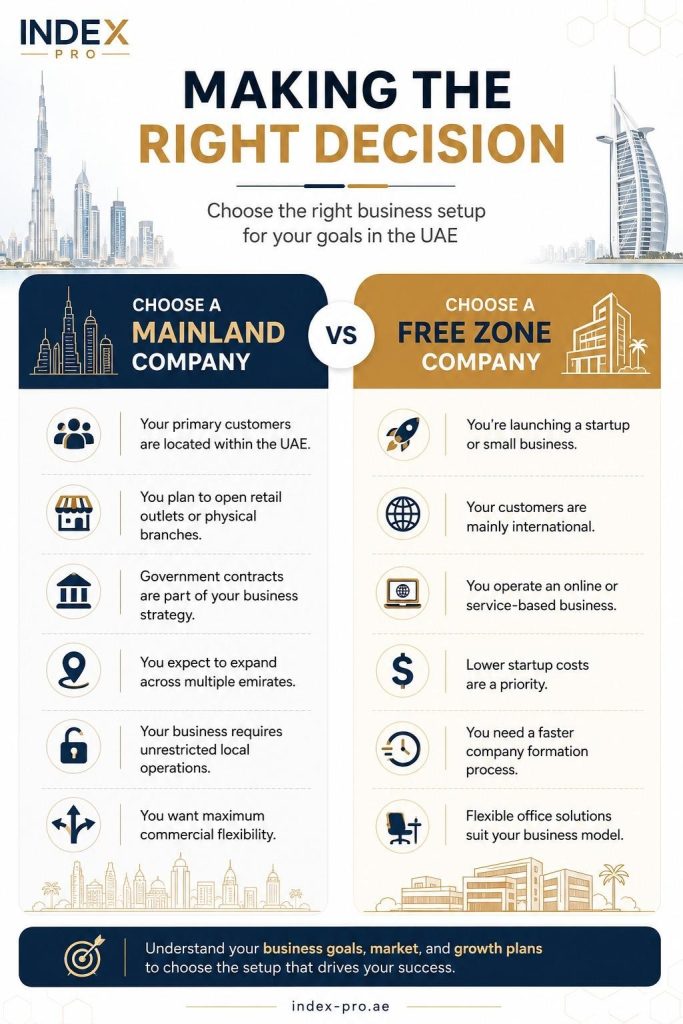
A Mainland business generally provides greater freedom to serve customers throughout the UAE without additional commercial arrangements. This makes it particularly suitable for businesses that expect to expand into multiple emirates, open retail outlets, or provide on-site services across the country.
A Free Zone company is often the preferred choice for entrepreneurs whose clients are located overseas or whose operations are primarily digital. Consultants, technology firms, online businesses, and international trading companies frequently choose Free Zones because they combine simplified company formation with attractive tax incentives and lower operational costs.
Your future plans matter just as much as your current business model. Selecting a structure that supports your long-term growth can reduce the need for restructuring as your company expands.
Final Thoughts
The debate around Mainland vs Free Zone isn’t about identifying a single winner. Both business structures have helped thousands of entrepreneurs establish successful companies in the UAE, but they serve different purposes.
If your focus is local market access, operational freedom, and long-term expansion across the UAE, a Mainland company may provide the flexibility your business needs.
If affordability, faster setup, international operations, and startup-friendly packages are more important, a Free Zone company is often the smarter choice.
Before making a final decision, compare licensing requirements, office obligations, visa eligibility, renewal costs, and your long-term business objectives rather than choosing solely based on the lowest registration fee.
Need Expert Advice on Choosing the Right Business Structure?
Selecting between a Mainland and Free Zone company is a strategic decision that can shape your business’s future. IndexPro helps entrepreneurs compare UAE business structures, understand licensing requirements, evaluate costs, and complete the company formation process with confidence. Whether you’re launching your first startup, expanding into the UAE market, or choosing the most suitable jurisdiction for your business, our experienced team provides practical guidance every step of the way.
Frequently Asked Questions
Is a Mainland company better than a Free Zone company?
Not necessarily. The better option depends on your business activity, customer base, budget, and expansion plans.
Can a Free Zone company do business in the UAE?
Yes, but depending on the business activity, additional approvals, distributors, or commercial arrangements may be required for certain local operations.
Which option is cheaper?
Many Free Zone company formation packages have lower entry costs, although the total operating cost depends on visas, office requirements, and business growth.
Do both allow 100% foreign ownership?
Yes. Many Mainland activities now allow 100% foreign ownership, and Free Zones have long provided full foreign ownership.
Which is better for startups?
Many startups choose Free Zones because of their affordable licensing packages, flexible office options, and streamlined registration process.
Can I upgrade or change my business structure later?
Yes. Businesses can restructure or establish additional entities as they grow, although this involves additional procedures and costs.