
A founder plans to sell across the UAE, hire quickly, and pitch to corporate clients – then gets stuck on one early question: mainland or free zone? The mainland vs freezone company decision shapes how you trade, where you operate, what approvals you need, and how easily you can scale. It is not just a licensing detail. It is a commercial decision that affects your next few years.
For many investors entering Dubai, both options look attractive at first glance. Free zones are often associated with speed, specialized ecosystems, and founder-friendly setup packages. Mainland companies are usually seen as the better fit for broader market access and long-term operational flexibility. The right choice depends less on what is cheaper on day one and more on how your business will actually earn revenue.
Mainland vs freezone company: what is the difference?
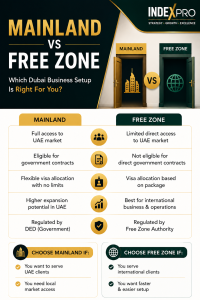
A mainland company is licensed by the relevant Department of Economy and Tourism or equivalent authority in the emirate where you establish the business. In Dubai, that means you can generally trade within the local UAE market, work with government-related opportunities where permitted, and operate with fewer geographic restrictions.
A free zone company is established under a specific free zone authority. Each free zone has its own rules, activity lists, facility requirements, and administrative processes. Free zones were designed to attract investment by offering industry-focused business environments and a streamlined setup path for many types of companies.
The simplest way to think about it is this: mainland usually gives you wider access to the UAE market, while free zone often gives you a more contained setup model with authority-specific benefits. That distinction matters most when you define your customers. If your revenue will come from clients across Dubai and the wider UAE, the setup structure should match that reality.
When mainland makes more sense
If you want to trade directly in the local UAE market without unnecessary structural workarounds, mainland is often the stronger route. This is especially true for retail, food and beverage, construction-related activities, logistics support, consulting firms that expect a broad local client base, and service businesses that need freedom to work across multiple jurisdictions.
Mainland can also be the better fit if physical presence matters. Businesses that need storefronts, larger offices, warehouses in certain locations, or teams deployed across the city usually benefit from that operational flexibility. For companies planning to grow headcount steadily, negotiate with local suppliers, or serve both private and public sector clients, mainland can support a more open commercial model.
That does not mean mainland is automatically better. It can involve more approvals depending on the activity, municipality requirements in some cases, and a setup path that needs careful coordination. But if your business model depends on local access, flexibility usually outweighs the added complexity.
When a free zone company is the smarter choice
Free zones can be an excellent option for founders who want efficiency, lower initial complexity, and an environment aligned with a specific industry. Many digital businesses, holding companies, e-commerce operators, international trading firms, media businesses, and advisory companies begin in free zones because the setup can be straightforward and the ecosystem often suits cross-border operations.
A free zone structure may also work well if your clients are primarily outside the UAE, or if your activity does not require direct access to the wider local market in the same way a mainland business would. In those cases, the free zone model can be cost-effective and practical, especially during the early stage of market entry.
Another reason founders choose free zones is predictability. Many authorities offer bundled packages that can make budgeting easier at the beginning. That said, not all free zones are the same. The right authority for a consultancy may be the wrong one for logistics, manufacturing, or regulated financial activity. Choosing a free zone based only on headline cost is one of the most common setup mistakes.
Ownership, control, and legal structure
Ownership rules have evolved significantly in the UAE, and many activities now allow full foreign ownership on the mainland. This has changed the conversation for international investors who previously assumed free zone was the only path to retain control. Today, the better question is not just who owns the company on paper, but which structure best supports your licensing activity, approvals, and expansion goals.
Legal structure also matters. Some founders need a simple entity for lean operations. Others need a structure that supports multiple shareholders, investor entry, branch expansion, or future restructuring. Mainland and free zone options can both accommodate serious business plans, but the practical details differ by authority and activity.
This is where tailored advice becomes valuable. A business setup should reflect your real operating model, not a generic preference for one jurisdiction over another.
Market access is the real dividing line
In a mainland vs freezone company comparison, market access is usually the deciding factor. A mainland company is generally better positioned for direct business across the UAE. A free zone company can still operate successfully, but the route depends on the activity and how services or goods reach the customer.
For example, a founder running an online consultancy for overseas clients may not need full mainland access at the start. A distributor aiming to build relationships with UAE retailers almost certainly will. A professional services company targeting private sector clients across Dubai may find mainland more practical from the beginning, even if the setup cost is not the lowest available.
The key is to avoid choosing a structure that restricts sales later. Fixing the wrong setup is usually more expensive than building the right one from the start.
Cost matters, but only in context
Many investors approach this decision by asking which option is cheaper. That is understandable, but incomplete. Setup cost is only one part of the financial picture. You also need to consider renewal fees, visa requirements, office obligations, authority charges, banking expectations, and the cost of changing structure later if the company outgrows its original model.
A low-cost free zone package may look attractive until the business needs additional visas, a larger office solution, broader local access, or revised licensing activity. On the mainland, higher upfront requirements in some cases may be justified if they support direct market entry and faster revenue generation.
The right cost question is this: which structure creates the lowest friction between your business and its customers? That answer is often more valuable than the lowest incorporation fee.
Banking, visas, and operations
Founders should also think beyond the trade license. Banking can be influenced by business activity, substance, shareholder profile, and the clarity of the company’s operating model. A well-structured application with the right documentation matters more than marketing claims about how fast setup can happen.
Visas and workspace requirements also differ. Some free zones are ideal for small teams or founders who want flexible desk options. Mainland businesses may offer greater freedom in how they establish a physical operating presence, depending on the activity and office needs. If your business plan includes hiring, client meetings, inventory, or expansion across departments, operational setup deserves as much attention as registration itself.
This is where an experienced partner can save time and reduce risk. IndexPro often supports clients not just with company formation, but with the practical decisions around licensing, documentation, compliance, and operational readiness that follow.
How to choose the right structure
The best decision starts with four questions. Where will your customers be? What activity will generate revenue? How many visas and how much physical infrastructure will you need? And what does growth look like over the next two to three years?
If your business depends on broad UAE market access, local contracts, and flexible on-the-ground operations, mainland is often the better choice. If your model is specialized, cross-border, lean, or early stage, a free zone can be the right launchpad. Neither option is universally better. Both can be effective when matched to the right strategy.
A smart setup does not just get the business registered. It supports sales, compliance, hiring, and expansion without forcing costly changes later. That is why the mainland versus free zone decision should be made with commercial reality in mind, not just speed or price.
The strongest business setups in Dubai usually begin with a clear picture of how the company will operate after the license is issued. If you start there, the right structure becomes much easier to see.