
A startup in Dubai can close a deal in the morning, hire a team member by lunch, and face a VAT, payroll, or reporting question by the end of the day. That pace is exactly why bookkeeping services for startups in Dubai are not a back-office extra. They are part of building a company that can grow without losing control of its finances.
For founders, the issue is rarely whether bookkeeping matters. The real question is when to set it up properly and who should manage it. In most cases, the right answer is earlier than expected. Clean books lead to better decisions, lower compliance risk and give investors, banks and partners more confidence in the business.
Why bookkeeping is needed early for Dubai startups
Most early-stage businesses operate on a simple premise: keep invoices in one folder, track expenses on a spreadsheet and sort out the rest later. That approach may work for a short period, but it usually breaks down as soon as the company starts invoicing regularly, hiring staff, dealing with reimbursable expenses, or preparing for tax obligations.
Dubai offers a strong environment for startups, but it is also a structured one. Businesses need to think about licenses, renewals, banking records, VAT where applicable, and documentation that stands up to review. Financial records are not separate from those obligations. They back them.
Good bookkeeping provides founders with a clear picture of cash on hand, outstanding receivables, recurring expenses, and profit trends. Just as importantly, it creates discipline. When records are updated consistently, leadership can spot problems early, not three months later when cash is tight and decisions become reactive.
What bookkeeping services for startups should actually include
Not every bookkeeping provider is built for startup needs. A young company does not need unnecessary complexity, but it does need accuracy, consistency and a framework that can scale.
From a practical perspective, bookkeeping should involve recording transactions, reconciling bank accounts, classifying expenses, tracking invoices, managing accounts payable and receivable, and preparing monthly financial reports. If the startup is registered for VAT, bookkeeping should also help ensure correct tax treatment and filing readiness, feeding directly into corporate tax obligations when the business passes the profit threshold.
The best support goes beyond entering numbers into software. It should help founders understand what those numbers mean. A clean profit and loss statement is useful. Knowing why margins are tightening, which costs are rising too quickly, or whether customer collections are slowing is far more valuable.
For startups planning to raise capital or apply for banking facilities, bookkeeping also needs to produce consistent, credible records. Investors rarely expect a small company to have a full finance department. They do expect financials that are organized, traceable, and professionally maintained.
What it costs
Outsourced bookkeeping in Dubai usually is based on transaction volume and business phase rather than a simple flat fee:
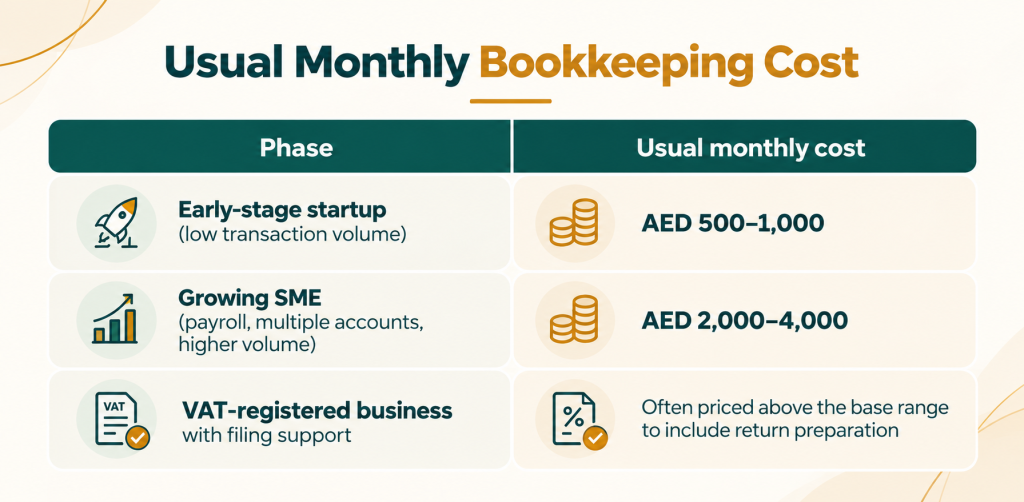
Figures above reflect general Dubai market ranges for outsourced bookkeeping as of 2026 and are provided for indicative purposes only. Actual pricing depends on transaction volume, entity complexity, and scope of service. Contact IndexPro for a quote specific to your business.
An in-house bookkeeper avoids a per-month service fee but adds salary, visa sponsorship, medical insurance, office space, and software licensing, costs that are hard to justify until transaction volume really necessitates a dedicated, full-time role.
In-house vs outsourced bookkeeping
This is where many founders hesitate. Hiring internally may feel like more control, while outsourcing may seem like something to postpone until the business is larger. It really depends on the volume of transactions, the structure of the team, the budget, and the growth plans.
If a company has a lot of activity in terms of transactions or needs daily administration of finances, then an in-house bookkeeper can make sense. The trade-off is cost, as detailed above: salary, visas, office overhead, supervision, and software all add up. For a startup still protecting runway, that can be difficult to justify.
Outsourced bookkeeping is often the more practical option in the early and growth stages. It gives the business access to expertise without the fixed cost of building a full internal function. It can also reduce the risk of founder-led bookkeeping, which tends to become inconsistent when operations get busy.
The important part is to select a provider that knows the realities of startups in Dubai. That means knowing how local compliance works, what documents matter, and how to build reporting that supports both management and regulatory requirements.
Common bookkeeping mistakes startups make
Most bookkeeping issues do not begin with negligence. They begin with speed. Founders are focused on sales, staffing, product development, and market entry. Finance admin becomes something to revisit later.
Many startups make the mistake of mixing personal and business expenses. Another mistake is not reconciling bank accounts regularly. Some startups will produce invoices but fail to properly track collections, which inflates revenue. Others record expenses late, so monthly reports look healthier than reality.
There is also a compliance angle. If VAT applies, poor bookkeeping can lead to incorrect filings, missing backup documentation, or weak audit trails. Even where the problem starts small, it can become expensive once penalties, corrections, and delays are involved.
A less obvious issue is decision quality. Founders often rely on intuition when records are incomplete. Intuition is vital to entrepreneurship, but it can’t replace a solid grasp of burn rate, vendor commitments, and revenue performance.
How good bookkeeping supports growth
Startups often see bookkeeping as a cost-control measure. It is, but it’s also much more than that. Accurate records are the foundation for hiring plans, pricing decisions, expansion timing, and capital planning.
When a founder wants to open up a second location, enter a new market segment or increase marketing spend, the business needs a reliable picture of current performance. Without that, growth decisions are based on assumptions. Good accounting enables management to determine whether margins will support growth, if customer payment cycles are straining cash flow and if fixed overhead is increasing too rapidly.
This is even more critical with multiple entities, shareholders or sources of income. Financial complexity grows faster than many startups expect. A bookkeeping setup that works for a two-person company may fail when the business adds payroll, inventory, project billing, or cross-border transactions.
That is why the best bookkeeping systems are designed not just for current activity, but for the next stage of growth.
What founders should look for in a bookkeeping partner
Founders do not need a provider that simply processes paperwork. They need a partner who brings order, consistency, and practical insight.
Start with reliability. Don’t have the books behind. Then look at quality of reporting. Monthly numbers should be clear and useful for management decision. Knowledge of industry is also important. A service business, e-commerce startup, consultancy, and tech company all have different reporting needs.
Communication is another factor that gets overlooked. If a startup has to chase its bookkeeping team for updates, explanations, or missing reconciliations, the support model is not working. Good providers identify issues and risks early.
It’s also useful when bookkeeping is part of a broader business support ecosystem. In Dubai, finance, legal compliance and licensing tend to be intertwined. A company like IndexPro can add value here because founders often need more than just accounting records. They need coordinated support that integrates setup, compliance, and financial organization from the start.
When to upgrade your bookkeeping setup
There are a few obvious signs. If month-end reporting is always late, if cash flow feels unclear despite healthy sales, or if VAT preparation has become stressful, the current process is no longer enough.
Another sign is fundraising preparation. Once investors begin due diligence, inconsistent bookkeeping becomes visible very quickly. The same is true when applying for loans, preparing board reporting, or planning a business sale.
Growth itself is also a trigger. More transactions, more staff, more suppliers, and more customers all increase the need for control. Waiting until the business feels financially messy usually means the cleanup will take longer and cost more than setting things up properly in the first place.
Bookkeeping as a founder advantage
Strong founders pay attention to numbers, but they do not need to spend their week manually sorting every transaction. The goal is not to become the bookkeeper. The goal is to build a finance function that keeps the company informed, compliant, and ready for the next move.
Bookkeeping done well creates confidence. It helps founders speak clearly with investors, answer bank questions, plan hiring responsibly, and make decisions based on facts instead of guesswork. In a market as fast-moving and opportunity-rich as Dubai, that kind of clarity is not administrative detail. It is a competitive advantage.
The sooner a startup incorporates bookkeeping into its growth infrastructure, the easier it is to scale with control, credibility, and fewer costly surprises.
FAQ
What does bookkeeping services for a startup cost in Dubai?
Outsourced bookkeeping generally costs AED 500-1,000 per month for an early stage startup with low transaction volume. This increases to AED 2,000-4,000 per month for a growing SME with payroll and higher activity. VAT return preparation is often priced above this base range.
Should a startup hire an in-house bookkeeper or outsource?
Outsourcing is usually more practical in the early and growth stages, since it avoids the salary, visa, insurance, and office costs of a full-time hire. In-house bookkeeping usually makes sense when transaction volume and daily finance admin really justify a role.
Do I need bookkeeping if my startup isn’t VAT-registered yet?
Yes. Clean records are important for cash flow visibility, investor readiness and bank applications regardless of VAT status, and they make the eventual VAT registration process much smoother when the business hits the threshold.
What’s the difference between bookkeeping and financial planning?
Bookkeeping is the daily record-keeping: transactions, reconciliation, invoicing and monthly reporting. Those records are used in financial planning to guide future decisions like budgeting, fundraising and growth strategy. Startups generally need bookkeeping from day one and financial planning as they scale.
When is it time for a startup to upgrade its bookkeeping setup?
Typical signs include consistently late month-end reporting, unclear cash flow despite healthy sales, stressful VAT preparation or the beginning of investor due diligence. Upgrading before these become urgent is cheaper than cleaning up records under pressure.